Future Engineering,
Global Innovation

메인비주얼2

Calendar

연구성과

Research

2026년 05월 11일 월요일

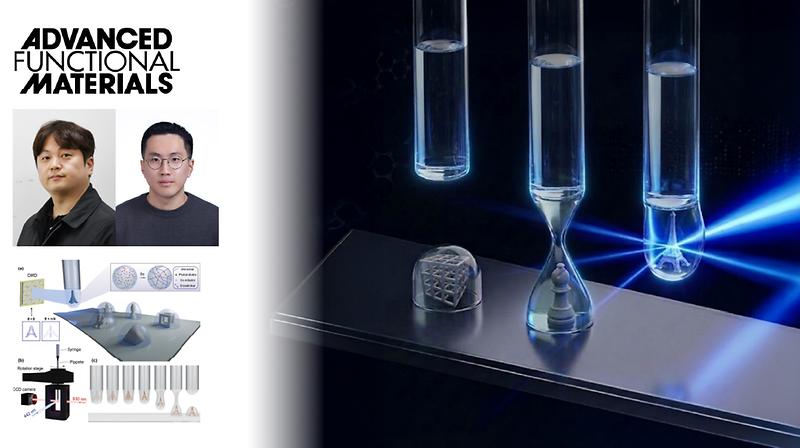
“60초에 하나씩 초고속 마이크로 3D 프린팅”...디스펜싱 체적 프린팅 개발

60초마다 3차원 마이크로 구조물을 연속적으로 인쇄할 수 있는 새로운 체적 적층 제조 기술이 개발됐다. UNIST 기계공학과 정임두 교수팀은 3차원 인쇄를 한층 단위가 아닌 불륨 단위로 하고, 연속 공정으로 다양한 형상을 빠르게 제조할 수 있는 ‘디스펜싱 체적 3D 제조(Dispensing Volumetric Additive Manufacturing)’ 기술을 개발했다고 29일 밝혔다. 개발된 디스펜싱 체적 3D 프린팅 기술은 피펫 끝에 맺힌 액체 원료 방울에 빛을 쏴 원하는 모양대로 굳혀(경화) 형상을 만드는 방식이다. 형상이 다 경화되면 공기압으로 피펫에서 액체 방울을 밀어내고, 새로운 액체 방울을 만든다. 한 층씩 쌓아 올려 형상을 만드는 일반적인 3D 프린팅 기술(layer-by-layer)과 달리 한 번에 형상 전체 볼륨을 만들 수 있어 제작 시간을 크게 단축할 수 있고, 층을 매끄럽게 다듬기 위한 별도의 후처리도 필요 없다. 기존에도 형상을 한 번에 만드는 체적 3D 프린팅 기술들이 있었지만, 체적 3D 프린팅 기술 중 하나인 회전 축 리소그래피(Computed Axial Lithography, CAL)는 매 인쇄 주기마다 원통형 용기에 수지를 채우고, 균일한 조사를 위해 굴절률 매칭 용액을 사용하며, 인쇄된 물체를 용기로부터 꺼내야 하는 작업이 필요해 다수 부품을 연속적으로 대량 생산하기 어려웠다. 연구팀은 수지가 담긴 별도의 용기 대신 유리 피펫에서 분사되는 단일 수지 방울 내에서 인쇄와 배출이 이루어지는 DVAM 기술을 개발해 이 문제를 해결했다. 수지 방울 자체가 인쇄 볼륨 역할을 하며, 회전하는 동안 단면 조사를 통해 용기와 굴절률 매칭 매질 없이도 수지 전체를 균일하게 경화시킬 수 있다. 인쇄 후 경화된 구조물은 기판 위로 배출되며, 다음 방울이 즉각적으로 공급돼 고속 연속 생산이 가능하다. 기술 개발의 가장 큰 난관은 액적의 둥근 표면 때문에 생기는 빛의 굴절이었다. 연구팀은 인공지능과 역 광선 추적의 광학 계산 기술을 결합해 이를 해결했다. 딥러닝 기반 사물 인식 AI가 액적의 곡률과 윤곽을 실시간으로 인식하면, 이를 바탕으로 빛의 굴절 경로를 계산하여 왜곡 및 경화에 필요한 에너지를 미리 수학적으로 보정한 패턴을 투사한 것이다. 이를 바탕으로 ‘에펠탑’이나 ‘생각하는 사람’과 같은 복잡한 구조를 프린팅할 수 있으며, 프린팅 시간 및 프린팅 외 작업 시간을 포함해서 10분 안에 각기 다른 10개 형상들을 제조할 수 있다. 구조물 하나를 만드는데 걸리는 시간은 60초 내외였다. 제 1 저자로 참여한 전홍령 학생은 “기존 3D 프린팅 원리와는 다르게 전체 형상을 볼륨 단위로 한번에 경화시키고, 또한 별도의 추가 공정없이 연속으로 바로 디스펜싱하도록 하여 3D 프린팅 속도를 백배 이상 향상 시켰다”며, “서로 다른 형상의 3차원 마이크로 부품을 쾌속으로 대량 생산할 수 있는 가능성을 보여주었다”고 했다. 연구를 총괄한 교신 저자인 정임두 교수는 “맞춤형 제조가 가능한 3D 프린팅 기술의 경우 느린 제조 속도가 항상 단점으로 지적되는데, 기존 광경화 방식에서 벗어나 전체 볼륨을 한번에 생산하고, 이때 발생하는 광학적 왜곡 한계를 인공지능 기술로 해결함으로써 초고속 3D 프린팅의 가능성을 한 단계 끌어올린 사례”라며, “이제는 원하는 형상을 제조하기 위해 오래 기다릴 필요 없이, 즉석에서 수십초 내에 만들 수 있는 시대가 되었다“고 했다. 연구 결과는 재료 과학 분야 세계적 학술지 (Impact Factor: 19.0, JCR 상위 5% 이내)인 ‘어드밴스드 펑셔널 머티리얼즈(Advanced Functional Materials)’에 3월 21일 온라인으로 게재되었다. 연구 수행은 과학기술정보통신부 한국연구재단과 정보통신기획평가원 및 산업통상자원부의 기술개발사업 지원으로 이뤄졌다.

2026년 04월 22일 수요일

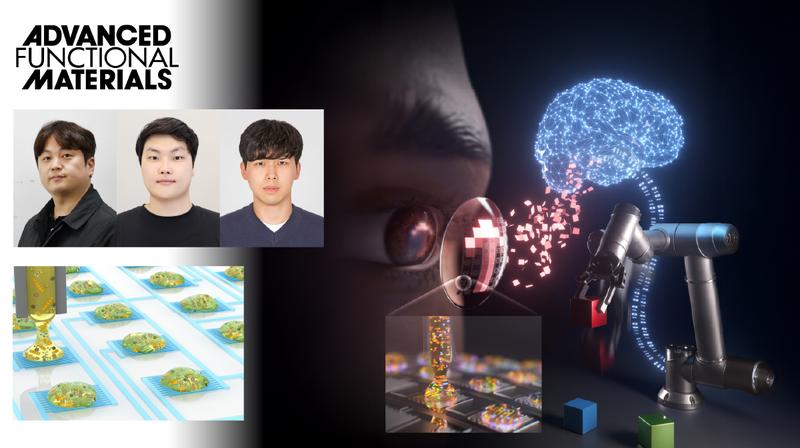
“눈짓만으로 로봇 조종한다”... AI 스마트 콘택트렌즈 개발

눈짓만으로 로봇을 움직일 수 있는 스마트 콘택트렌즈가 개발됐다. 렌즈를 낀 채 안구를 굴리면, 로봇 팔이 안구 방향을 따라 움직인다. 무겁고 복잡한 기존 확장현실(XR) 기기를 대신할 차세대 인간-기계 인터페이스 기술로 주목받고 있다. UNIST 기계공학과 정임두 교수(인공지능대학원 겸직) 연구팀은 센서를 렌즈에 직접 인쇄하는 특수 기술과 센서의 저해상도 신호를 고해상도로 복원하는 AI 기술을 결합해, 로봇 팔을 원격 제어할 수 있는 스마트 콘택트렌즈를 개발했다고 15일 밝혔다. 이 렌즈 위에는 100개(10x10)의 빛 검출 센서가 집적돼 있는데, 눈을 움직일 때마다 달라지는 빛 분포를 이 센서가 읽어내 시선 방향을 추적하는 원리로 작동한다. 위·아래·좌·우는 물론 대각선 방향까지 구분할 수 있으며, 이 시선 정보가 로봇 팔로 전달돼 팔이 움직인다. 안구의 깜박임으로 물건을 집을 수도 있다. 연구진은 둥근 렌즈 표면에 센서를 직접 프린팅할 수 있도록 ‘메니스커스 픽셀 프린팅(MPP)’ 기술을 개발해 적용했다. 노즐 끝에 맺힌 센서 원료 잉크를 렌즈 표면에 콕콕 찍어내는 형태의 기술이다. 메니스커스는 액체의 볼록하거나 오목한 곡면을 말하는데, 이 곡면 덕분에 잉크가 배출되는 힘과 잉크 퍼짐을 막는 힘이 균형을 이뤄 잉크를 원하는 양만큼 찍어낼 수 있다. 잉크를 건조하면 빛을 감지하는 페로브스카이트 물질만 남아 센서 역할을 하게 된다. 일반 센서 제작과 달리 센서 패턴을 새기기 위한 마스크가 필요 없고 다양한 안구 곡률에 맞춰 센서를 인쇄할 수 있어 개별 맞춤형 렌즈를 만들 수 있는 장점이 있다. 렌즈라는 작은 공간 탓에 신호 해상도가 떨어지는 문제는 인공지능 기술을 결합해 해결했다. 실제로는 100개의 센서가 있지만, 딥러닝 기반의 초해상도 기술을 적용하면 최대 6,400개(80x80)의 센서가 있는 것과 같은 신호 데이터를 얻을 수 있다. 재구성에 필요한 시간도 0.03초로 짧아 정보가 실시간 수준으로 로봇 팔에 전달될 수 있다. 안구 모형을 이용한 실험에서, 눈동자 움직임만으로 물체를 집어 옮기는 동작까지 이뤄졌으며, 방향 인식 정확도는 99.3% 수준을 기록했다. 이번 연구는 UNIST 기계공학과 공병훈, 김도현 연구원이 제1저자로 참여했다. 연구팀은 “하드웨어적 공정 혁신과 AI 기반 신호 복원 소프트웨어 기술을 결합해 렌즈라는 초소형 폼팩터의 공간적 제약을 극복한 기술”이라고 설명했다. 연구를 총괄한 정임두 교수는 “별도의 컨트롤러 없이 인간의 시각 정보를 로봇 제어 신호로 직접 변환하는 고도화된 인간-기계 상호작용(Human-Robot Interaction, HRI) 시스템 구현이 가능함을 증명했다”며 “차세대 초경량 XR 인터페이스 장치로서 눈의 움직임만으로 다양한 전자 기기를 정밀하게 제어할 수 있다는 점에서, 증강현실 기반 산업용 로봇 원격 제어, 재난·재해 환경에서의 탐사 로봇 운용, 국방 분야의 무인체계 및 드론 조종, 의료 및 재활 지원 시스템, 스마트 모빌리티 인터페이스 등 다양한 분야로 확장될 수 있는 잠재력을 지닌다“고 밝혔다. 연구 결과는 재료 과학 분야 세계적 학술지 (Impact Factor: 19.0, JCR 상위 5%이내)인 ‘어드밴스드 펑셔널 머티리얼즈(Advanced Functional Materials)’에 3월 11일 게재되었으며, 최신 호 전면 표지 논문으로 선정되어 출판될 예정이다. 연구 수행은 과학기술정보통신부 한국연구재단과 정보통신기획평가원 및 산업통상자원부의 기술개발사업 지원으로 이뤄졌다.

2026년 04월 10일 금요일

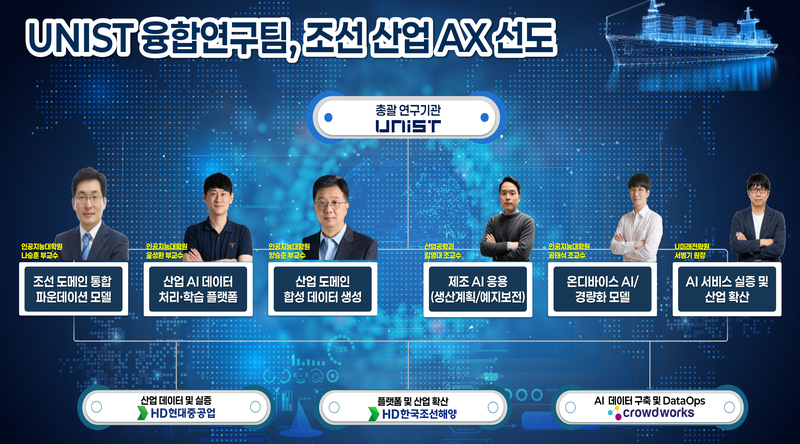
UNIST 교수진, 조선업 AI 전환 이끈다

UNIST가 조선업의 AI 전환(AX, AI Transformation)을 이끌 초거대 산업 AI 개발 연구에 본격 착수한다. 이번 연구는 인공지능대학원, 산업공학과, 컴퓨터공학과, 기계공학과, 경영과학부 등 다양한 학과 교수진이 참여하는 대규모 융합 연구로 추진된다. 과학기술정보통신부 ‘초거대산업 AI연구지원사업’에 조선 분야로 도전하여 최종 선정된 이번 연구는 총 403억원(국비 285억원, 시비 25억원, 기업부담금 93억원) 규모로 추진되며, 조선소에서 생성되는 데이터를 기반으로 산업 특화 초거대 AI를 개발하고 실제 현장에 적용하는 것을 목표로 한다. 이번 프로젝트는 총 6개 세부과제로 구성되며, 각 분야별 UNIST 교수진이 참여해 조선 산업 전반의 AI 혁신을 이끌 계획이다. 먼저 ‘산업 도메인 특화 멀티모달 초거대 AI 모델 개발’ 과제에는 반도체 소재·부품 대학원의 김성엽 교수를 비롯해 인공지능대학원 나승훈, 장영수, 백승렬, 김태환 교수와 기계공학과 정하영 교수가 참여해 조선업 특화 멀티모달 AI 파운데이션 모델 개발을 담당한다. 이 파운데이션 모델은 조선소에서 생성되는 다양한 데이터를 통합 학습하는 핵심 엔진으로, 이후 데이터셋 구축, 플랫폼 개발, 공정 최적화 및 현장 실증 등 전 세부과제의 기반 기술로 활용된다. ‘지능형 AI 처리·학습 플랫폼 기술 개발’ 과제에는 인공지능대학원 윤성환, 심재영, 이연창 교수와 산업공학과 박새롬 교수, 컴퓨터공학과 위성일 교수가 참여해 대규모 산업 데이터를 효율적으로 처리·학습할 수 있는 산업 데이터 학습 플랫폼 구축에 나선다. 또한 ‘산업 도메인 특화 데이터셋·합성 기술 개발’ 과제에는 인공지능대학원 양승준, 김지수, 이연창 교수가 참여해 효율적이고 범용적인 AI 모델 학습을 위한 실제 데이터의 한계를 보완하고 다양한 상황을 포괄할 수 있는 합성데이터 생성 연구를 진행한다. ‘제조·예지보전 및 공정 최적화 기술 개발’ 과제에는 산업공학과 김영대, 김성일, 나형호, 임동영, 임치현 교수와 컴퓨터공학과 김정훈 교수, 인공지능대학원 최진영 교수, 기계공학과 하준형 교수가 참여해 조선업 특화 파운데이션 모델을 기반으로 설계-중일정 계획 공정을 연계한 자동화·최적화 기술을 개발한다. 또한 협동로봇의 예지보전과 지능화된 운용체계 구축도 함께 추진할 계획이다. 이와 함께 ‘산업 도메인 특화 온디바이스 AI 기술 개발’ 과제는 컴퓨터공학과 공태식 교수, 이종은, 황랑기 교수가 맡아 조선 도메인 특화 적응·경량·최적화된 온디바이스 AI 기술을 개발하며, ‘산업 도메인 특화 멀티모달 초거대 AI 서비스 실증’ 분야에는 경영과학부 서병기 교수와 기계공학과 김남훈 교수가 참여해 개발된 기술의 산업 현장 적용과 확산을 담당한다. 이번 연구는 학과 간 경계를 넘는 융합 연구 체계를 기반으로 추진된다는 점에서 의미가 크다. 인공지능 기술 개발뿐 아니라 산업공학 기반의 최적화, 컴퓨터공학 기반 시스템 구현, 기계공학 기반 현장 적용, 경영과학 기반 실증 및 확산까지 전주기를 아우르는 연구 구조가 특징이다. 또 HD현대중공업, HD한국조선해양, 크라우드웍스와의 협력을 통해 산업 현장의 실제 데이터를 기반으로 연구가 진행되며, 개발된 기술은 현장에 적용·검증되는 실증 중심 연구로 추진된다. 대규모 언어모델(LLM) 전문가로서 이번 세부 과제 간 조율을 맡은 나승훈 교수는 “이번 사업은 산업 특화 AI 파운데이션 모델과 응용기술을 개발하는 데 의미가 있다”며 “앞으로 생산계획, 공정, 품질 관리 등 피지컬 AI를 포함한 조선 산업 전반의 AI 전환을 이끄는 중요한 기반이 될 것”이라고 밝혔다. 이어 “이를 통해 제조 산업 AI 분야에서 UNIST의 연구 수월성을 입증해 나가겠다”고 덧붙였다. 한편, UNIST 연구처는 이번 사업을 연구몰입환경 구축을 위한 '연구행정 Pre-Award 시범사업'으로 선정하여 과제 기획, 예산 편성, 자료 작성 및 취합 등 연구자가 대형과제를 수주하는 데 필요한 행정 지원을 수행하였다. 앞으로도 연구 수월성 제고를 위한 UNIST만의 R&D매니지먼트 모델을 정립하고 연구행정 선진화를 선도해 나갈 계획이다.

2026년 03월 31일 화요일

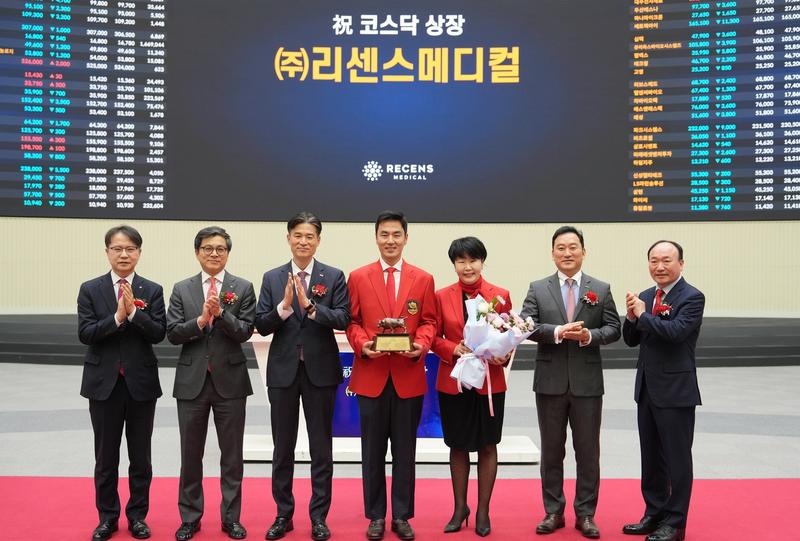
UNIST 기술사업화 전략 결실 맺다… 교원창업기업 코스닥 상장

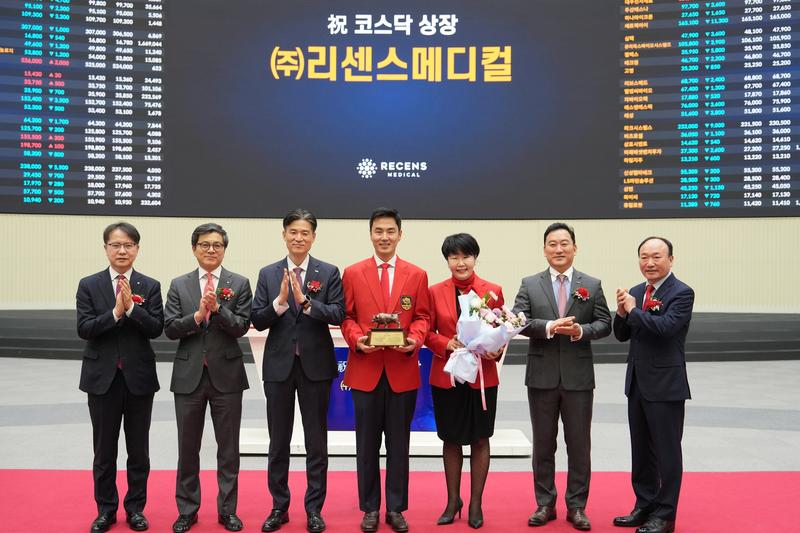
UNIST가 키운 창업기업이 코스닥 상장에 성공했다. 창업부터 제조, 투자, 해외 진출까지 지원해 온 ‘R&D 스케일업(Scale-up)’ 전략의 결실이다. 31일(화) 코스닥 시장에 상장한 리센스메디컬(공동대표 김건호, 최의경)은 2016년 설립된 UNIST 교원창업기업이다. 기계공학과 김건호 교수의 연구실이 보유한 ‘급속정밀냉각’ 기술을 기반으로 피부과나 안과 시술, 동물 의료 분야에 필요한 정밀 냉각 의료기기를 개발하고 있다. 리센스메디컬의 핵심 기술은 생체조직의 온도 실시간으로 읽고, 시술 부위에 맞춰 냉각 강도와 작동 시간을 정밀하게 조절하는 데 있다. 화학 마취에 의존하던 의료 현장에 새로운 마취 방식을 들여와 통증을 줄이고 처치 시간을 단축했다. 김건호 대표(기계공학과 교수)는 “리센스메디컬은 UNIST 원천기술을 의료 현장이 필요로 하는 제품으로 발전시키며 새로운 시장을 개척해 왔다”며 “앞으로 해외 허가를 확대하고 판매망을 넓혀 정밀 냉각 의료기기 분야에서 본격적으로 세계 시장에 진출하겠다”고 밝혔다. 리센스메디컬의 코스닥 상장은 UNIST가 기초·원천 연구성과에 창업보육, 사업화 인프라 등을 체계적으로 지원해 시장에서 통하는 기업으로 키워낸 결과다. UNIST는 연구 단계부터 원천기술의 가치를 극대화하기 위한 특허 장벽을 촘촘히 쌓고, 창업 초에는 창업보육실에 입주시켜 연구개발과 상용화를 함께 추진한다. 시제품 제작과 투자, 해외 진출 등을 지원하는 프로그램도 운영하고 있다. 리센스메디컬은 기술 실증과 제품화, 해외 진출 부분에서 UNIST 창업지원 시스템의 혜택을 받았다. 먼저 식품의약품안전처에서 시제품의 제조와 제품을 허가하는 데에 UNIST가 마련한 GMP 인증 생산 시설이 큰 역할을 했다. 또 해외 진출은 UNIST가 2017년부터 UC샌디에이고(UCSD)에서 운영하는 글로벌 창업 멘토링 프로그램의 덕을 봤다. 이 프로그램은 창업기업이 미국 시장 적합성 검토, 인허가 자문, 전문기관 협업, 현지 법인 설립, 투자 매칭 등을 추진하도록 지원하는데, 리센스메디컬도 2018년부터 지원을 받아 현지 전문가들과 접점을 넓히고 미국 임상과 사업 전략을 구체화했다. 박종래 총장은 “UNIST는 원천기술 단계부터 사업화를 겨냥한 ‘R&D 스케일업’ 전략을 가지고 있다”며 “리센스메디컬의 경우는 기술 실증을 위한 생산 시설과 해외 진출을 위한 네트워크 부분에서 UNIST의 도움이 주효했을 것”이라고 분석했다. 상용화 제품 출시와 수출 기반 마련에 성공한 리센스메디컬은 투자 유치를 통해 성장세를 이어왔다. 2017년 울산 최초의 팁스(TIPS) 창업팀으로 선정된 데 이어, 2022년에는 UNIST 자회사 유니스트기술지주㈜ 운용 펀드로부터 자금을 확보했다. UNIST가 기술핵심기관을 맡은 울산울주 강소연구개발특구도 힘을 보탰다. 연구장비와 실증 인프라를 개방하고 기술이전사업화(R&BD) 자금을 투입했으며, 민간 투자와 해외 멘토링을 연계해 딥테크 기업 육성을 뒷받침했다. 박 총장은 “UNIST는 성장 단계별 투자와 글로벌 협력을 아우르는 창업 플랫폼으로서의 기능도 강화하고 있다”며 “앞으로도 연구실 성과가 창업과 산업 현장으로 이어지도록 적극 지원해 국가 경쟁력 제고에 기여하겠다”고 강조했다. 한편, 리센스메디컬은 피부 시술과 안과, 동물 의료 분야에서 통증을 줄이고 처치 시간을 단축하는 정밀 냉각 의료기기를 개발해 왔다. 피부과용 타겟쿨(TargetCool), 안과용 오큐쿨(OcuCool), 동물용 벳이즈(VetEase)가 주력 제품이다.

2026년 02월 04일 수요일

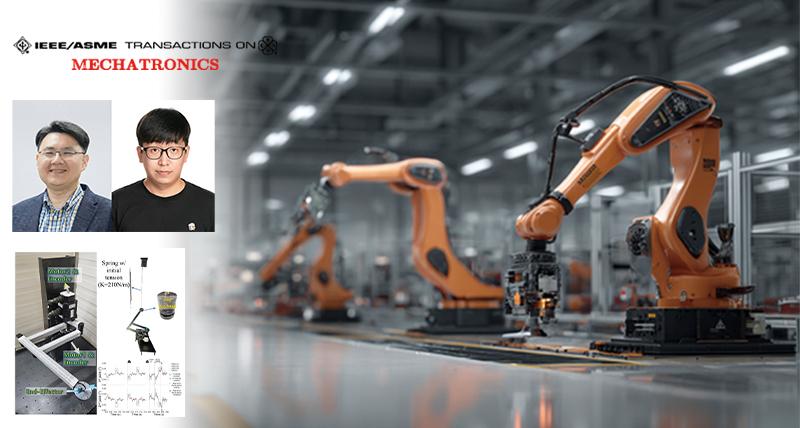
로봇팔, 갑자기 무거운 짐 들어도 안 떤다!.. 적응형 제어 기술 개발

갑자기 무거운 짐을 들어도 덜덜 떨지 않는 로봇팔을 만드는 제어 기술이 나왔다. 산업 현장 로봇팔 90%에서 쓰는 제어기의 소프트웨어만 업데이트하면 바로 쓸 수 있는 기술이다. UNIST 기계공학과 강상훈 교수팀은 급격한 부하 변동이나 외부 충격에도 로봇팔이 잘 작동할 수 있게 하는 ‘적응형 PID 제어 알고리즘’을 새롭게 개발했다고 26일 밝혔다. PID 제어기는 로봇팔의 ‘운동 신경’을 담당하는 일종의 두뇌이다. 로봇팔을 원하는 궤적대로 움직이기 위해 모터로 보내야 하는 힘을 실시간으로 계산해 준다. 구조가 단순하고 명확해 현재 산업 현장 로봇팔의 90% 이상이 이 방식을 사용하고 있다. 문제는 PID 제어 방식의 ‘융통성’이 부족하다는 점이다. 처음에 설정된 값으로만 움직이기 때문에, 로봇이 드는 물체의 무게가 갑자기 변하거나 외부 물체와 접촉하면 오작동하거나 심한 진동이 발생하곤 했다. 연구팀은 이 문제를 해결하기 위해 로봇이 오차 정보를 이용해 실시간으로 제어 값을 스스로 조절할 수 있도록 하는 알고리즘을 새롭게 개발했다. 이 알고리즘은 기존의 적응형 PID 기술과 달리 로봇팔 관절의 디지털 센서에서 발생하는 미세한 신호 잡음(양자화 오차)을 상쇄하도록 설계됐다. 기존 적응형 알고리즘은 성능을 높이려다 센서의 미세한 잡음에까지 반응하게 되면서 불필요하게 힘을 키우는 현상이 발생하고 시스템이 불안정해지는 경우가 많았다. 연구진이 개발한 기술의 가장 큰 장점은 하드웨어 교체 없이 소프트웨어 업데이트만으로 적용 가능하다는 점이다. 로봇의 복잡한 물리적 정보(질량, 마찰력 등)를 미리 입력하거나 고가의 무게 감지 센서를 추가할 필요가 없다. 이미 PID 제어기가 탑재된 로봇이라면 어디든 즉시 적용할 수 있다. 연구팀은 관절이 2개인 로봇팔에 이 알고리즘을 적용해 로봇팔 자체 무게에 달하는 짐을 들게 하거나, 강한 탄성의 스프링이 연결된 복잡한 환경을 만드는 실험을 진행했다. 실험 결과, 새로운 알고리즘이 적용된 로봇팔은 환경 변화에 맞춰 스스로 제어 값을 조절하며 흔들림 없이 목표 궤적을 따라갔다. 반면 기존 제어 방식은 위치 오차가 커지거나 불안정한 모습을 보였다. 강상훈 교수는 “산업용 로봇의 대다수를 차지하는 PID 제어기의 성능을 획기적으로 개선할 수 있다”며 “작업 환경이 자주 바뀌는 스마트 팩토리뿐만 아니라 사람의 미세한 힘 변화까지 감지해 반응해야 하는 재활 로봇, 휴머노이드 로봇 등 다양한 로봇 분야에 활용될 수 있을 것”이라고 밝혔다. 연구 결과는 기계 및 로봇 공학 분야의 세계적 권위지인 'IEEE/ASME 트랜잭션 온 메카트로닉스(IEEE/ASME Transactions on Mechatronics)'에 1월 13일 게재되었다. 이번 연구는 한국연구재단 미래유망융합기술파이오니어사업과 국립재활원 재활로봇중개연구용역의 지원을 받아 수행됐다.

2026년 01월 07일 수요일

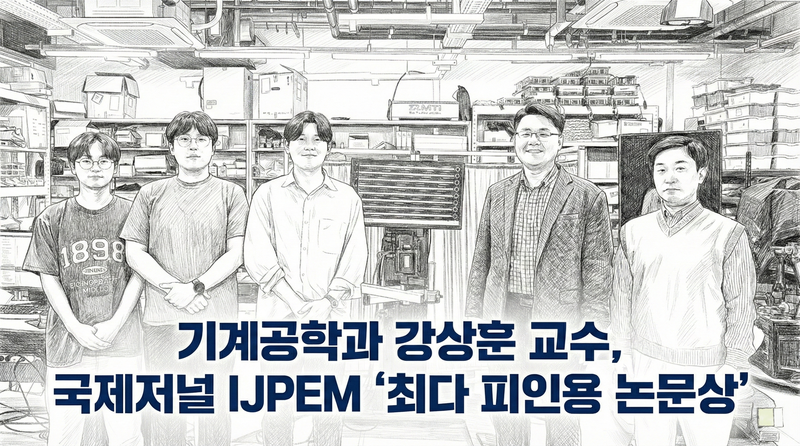
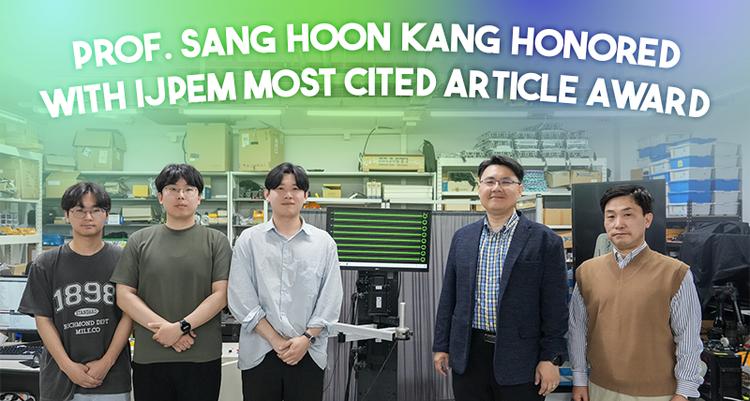
기계공학과 강상훈 교수, 국제저널 IJPEM ‘최다 피인용 논문상’

기계공학과 강상훈 교수가 로봇 제어 분야 국제 저널인 International Journal of Precision Engineering and Manufacturing(IJPEM)에서 선정하는 최다 피인용 논문상(Most Cited Article Award)을 받았다. 이번 수상은 IJPEM이 2023~2024년 동안 게재 논문 가운데 가장 많이 인용된 연구를 대상으로 수여했고, 강 교수 논문이 해당 기간 최다 인용 논문으로 꼽히며 학문적 영향력을 공식적으로 인정받았다. 논문은 「A Review on Robust Control of Robot Manipulators for Future Manufacturing」이다. 2023년 IJPEM 제24권 6호에 게재됐다. 로봇 매니퓰레이터의 강인 제어(Robust Control)를 주제로, 특히 시간 지연 제어(Time-Delay Control, TDC) 기법의 이론적 발전과 실제 적용 가능성을 체계적으로 정리했다. 강상훈 교수는 해당 논문에서 지난 30여 년간 축적된 TDC 연구 흐름을 집대성했다. 비선형성과 시변성이 커 제어가 까다로운 휴머노이드 로봇을 비롯해 재활 로봇, 산업용 로봇 등에서도 구조는 단순하면서도 안정적인 제어가 가능함을 종합적으로 제시했다. 이 분야 연구자들이 필요로 했던 체계적 정리가 높은 인용도로 이어졌다는 평가다. 강 교수는 “매우 비선형적이고 복잡한 로봇 시스템에서도 실질적으로 적용 가능한 제어 기법을 정리한 최초의 리뷰 논문이라는 점에서 의미가 크다”며 “많은 연구자들이 TDC에 대한 체계적인 정리를 필요로 했다는 사실이 인용 수로 증명된 것 같아 보람을 느낀다”고 말했다. 이어 “앞으로도 휴머노이드와 재활 로봇 등 다양한 환경에서 활용 가능한 더욱 강건하고 효율적인 제어 기법을 연구해 나가겠다”고 덧붙였다.

2025년 12월 24일 수요일

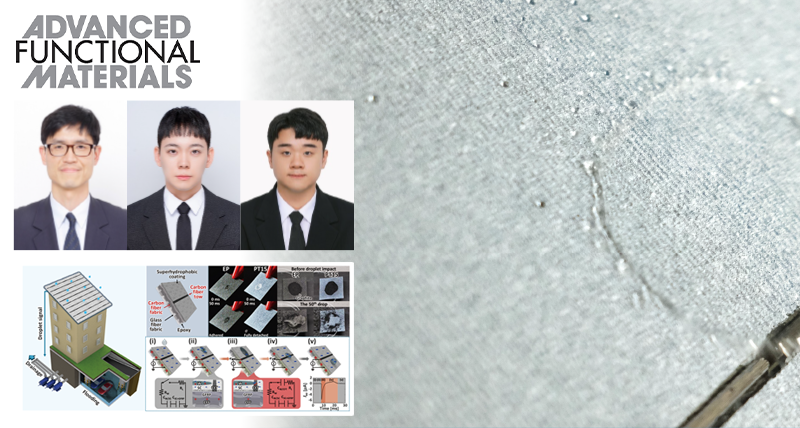
지붕이 빗물 튕겨내 전기 만든다!...탄소섬유 복합재 물방울 발전기 개발

지붕으로 떨어지는 빗물로 전기를 만들어 폭우 상황에서 배수 장치나 경보 시스템을 가동할 수 있게 하는 기술이 나왔다. UNIST 기계공학과 박영빈 교수팀은 빗방울로 전기를 만드는 탄소섬유 복합재 기반 물방울 발전기(액적 발전기, S-FRP-DEG)를 개발했다고 15일 밝혔다. 탄소섬유 복합재는 탄소섬유 다발을 플라스틱 수지에 섞은 소재로 가벼우면서도 강해 건물 지붕과 같은 외장재로 쓸 수 있는 소재다. 개발된 탄소섬유 복합재 발전기는 빗방울이 복합재 표면에 닿았다 빠르게 떨어지는 순간 전기를 만든다. 정전기와 흡사한 원리다. 빗방울은 양전하를, 복합재 표면은 음전하를 띠는데, 빗방울이 접촉했다 떨어지는 순간 전하 입자가 탄소섬유를 타고 이동하면서 전기가 흐른다. [연구그림] 탄소섬유 복합재 물방울 발전기(S-FRP-DEG)의 동작 개념과 전기 출력 과정 기존의 금속 기반 물방울 발전기는 금속이 빗속의 오염물질에 의해 쉽게 부식되는 문제가 있었는데, 연구팀은 부식에 강한 탄소섬유 복합재를 사용해 이를 해결했다. 또 복합재 표면을 특수 가공한 뒤 위에 코팅재를 입혀 발전기의 발전 성능을 높였다. 빗방울의 순간적 접촉 면적은 넓히되, 빗방울이 빠르게 구슬처럼 변해 표면에서 굴러떨어지도록 만든 것이다. 미세한 요철이 가공된 표면은 빗방울의 접촉 면적을 넓히고, 코팅재는 복합재 표면을 마치 연꽃잎처럼 만들어 빗방울이 튕겨 나간다. 코팅재는 도심 오염물이나 매연이 달라붙는 것도 막을 수 있어, 야외에 설치된 발전기가 성능을 오래도록 유지할 수 있다. 실험에서, 개발된 발전기는 약 92μL(마이크로리터) 크기의 빗방울 하나가 떨어질 때 최대 약 60V의 전압과 수 μA(마이크로암페어) 수준의 전류를 생산했다. 발전기 4개를 직렬로 연결했을 때는 LED 전구 144개를 순간적으로 점등하는 데 성공했다. 연구팀은 이 발전기를 지붕 모서리나 배수 덕트에 부착해 강우량을 실시간으로 감지하는 시연도 했다. 빗방울이 많이 떨어질수록 전기 신호가 더 자주 발생했고, 이 신호를 기준으로 배수 펌프를 켜는 방식이다. 약한 비, 보통 비, 강한 비 상황에 따라 펌프 작동 횟수가 달라져 침수 상황을 구분할 수 있게 된다. 이번 연구에는 이성환 박사와 김재진 연구원이 제1저자로 참여했다. 박영빈 교수는 “이 기술은 별도의 외부 전원 없이 빗물만으로 건물이나 교량 같은 도시 기반 시설을 관리하고 침수 피해를 예방하는 데 기여할 뿐만 아니라, 향후 항공기나 자동차 등 탄소섬유 복합재가 들어가는 모빌리티의 자가 전원 기술로 쓸 수 있을 것”이라고 밝혔다. 연구는 과학기술정보통신부 한국연구재단(NRF) 중견연구자 지원사업을 통해 수행됐으며, 그 결과는 소재 분야 국제 학술지인 ‘어드밴스드 펑셔널 머터리얼즈(Advanced Functional Materials)’에 11월 20일 온라인 공개됐다.

2025년 12월 11일 목요일

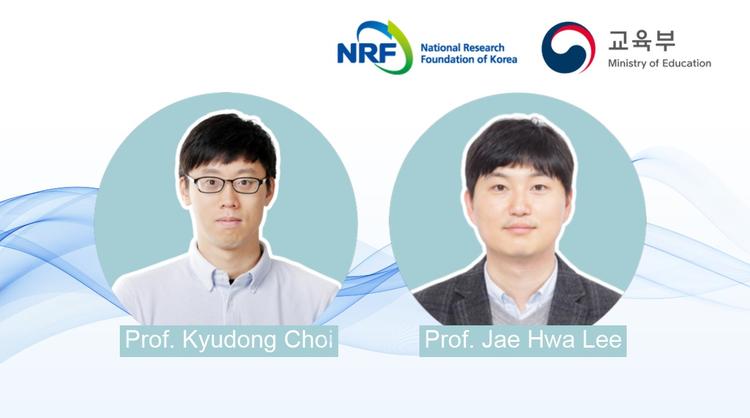
최규동·이재화 교수, 교육부 '학술연구지원 우수성과 50선’ 선정

수리과학과 최규동 교수와 기계공학과 이재화 교수가 교육부의 ‘학술연구지원 우수성과 50선’에 선정됐다. 올해는 2024년 학술연구지원사업 성과물 가운데 공모와 추천으로 245건이 접수됐고, 독창성·우수성·학술적 기여도 등 평가를 거쳐 50편이 뽑혔다. 선정된 성과에는 교육부 장관상이 주어졌으며, 시상식은 9일 서울 그랜드 인터컨티넨탈 호텔에서 열렸다. 최규동 수리과학과 교수는 130년간 풀리지 않았던 유체 회전 운동의 난제를 해결했다. 태풍처럼 둥글게 에너지가 모여 빠르게 회전하는 흐름을 설명하는 모델을 ‘힐(Hill) 구형 와류’라고 부른다. 문제는 이 흐름의 경계가 불연속적이라, 그동안 안정적으로 존재할 수 있는지 수학적으로 밝히기 어려웠다. 연구그림. 힐(Hill)이 발견한 구형 와류의 유선(streamline); 움직이는 좌표계를 나타낸다. 최 교수팀은 자연 현상과 더 가까운 경계 조건을 구현하는 새로운 계산법을 제시했다. 기존 이론이 다루기 힘들었던 ‘끊기는 변화 구간’을 부드럽게 잇는 방식을 마련해 복잡한 경계 문제를 처리할 수 있도록 했다. 이를 기반으로 구형 와류가 특정 조건에서 운동에너지를 극대화하며 안정적으로 존재한다는 사실을 세계 최초로 엄밀히 증명했다. 이 성과는 3차원 국지적 와류의 안정성을 이론적으로 정립했다는 점에서 의미가 크다. 논문은 수학 최상위 학술지 중 하나인 순수-응용수학저널(Communications on Pure and Applied Mathematics, CPAM)에 실렸으며, 대한수학회 논문상도 받았다. 최 교수는 “이번 연구가 우리나라 기초수학의 국제 경쟁력을 보여준 결과”라며, “유체 안정성 이론과 기후 변화 연구 등 여러 분야에서 이론적 기반을 넓히는 데 기여하길 바란다”고 말했다. 이재화 기계공학과 교수는 가오리의 유영 방식에서 새로운 수중 추진 원리를 찾아냈다. 몸 전체를 제어하는 기존의 능동 유연성과 달리, 가오리의 선단 부분만 제어하고 나머지는 유체와의 상호작용에 맡기는 수동 유연성에 주목했다. 연구팀은 이 방식이 가오리의 가장자리부터 몸체 주변까지 강한 와류 구조를 만들고, 고속 구간에서도 양의 압력을 유지한다는 사실을 확인했다. 연구그림. (a)능동 유연성과 (b)수동 유연성을 갖는 '가오리 주위의 시간에 따른 와구조 변화' 그 결과 적은 에너지로 더 큰 추력을 낼 수 있으며, 이는 기존 전신 구동 방식과는 다른 효율 중심의 새로운 패러다임을 제시한 연구로 평가 받는다. 이러한 연구 결과는 세계적 유체역학 학술지 ‘피식스 오브 플루이드즈(Physics of Fluids)’에 게재됐다. 이 교수는 “동료 연구자와의 협력과 융합 연구의 힘이 큰 도움이 됐다”며 “AI 기반 제어 기술을 결합해 주변 환경에 스스로 적응하는 자율 잠수정, 수중 정찰 로봇, 생물 모사형 추진체 등 수중 로봇 분야로 연구를 확장할 계획”이라고 말했다. 박종래 총장은 “두 연구자의 성과는 기초수학의 난제를 해결하고 공학적 혁신 기술을 제시한 사례”라며 “UNIST의 기초·응용 융합연구 전략이 실질적인 성과로 이어지고 있다”고 강조했다.

2025년 11월 07일 금요일

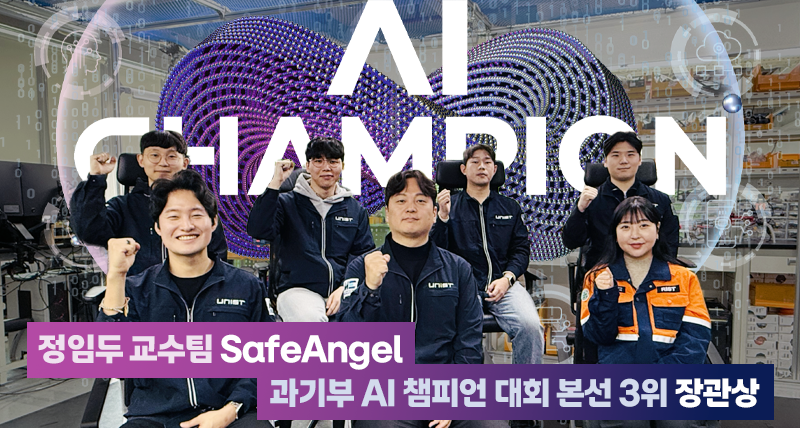
정임두 교수팀, 과기부 AI 챔피언 대회 장관상·AI 임팩터상!

기계공학과·인공지능대학원 정임두 교수 연구팀이 산업 현장 ‘소음 문제’를 AI 기술로 해결하며 전국 무대에서 우수한 성과를 냈다. ‘세이프엔젤(SafeAngel)’ 팀은 5일 서울 용산 드래곤시티 호텔에서 열린 과학기술정보통신부 주관 ‘2025년도 AI 챔피언 대회’ 본선에서 최종 3위를 차지해 과기부 장관상(AI 챌린저상)을 수상했다. 전국 630개 팀이 참가했으며, 치열한 경쟁 끝에 단 5개 팀만이 본선에서 수상의 영예를 안았다. 이번 대회는 올해 처음 열린 전국 규모 AI 기술 경연대회다. 예선을 거쳐 100팀, 20팀, 최종 결선 8팀으로 좁혀졌다. 이 가운데 세이프엔젤 팀은 실용성과 기술 완성도, 사회적 파급력 면에서 모두 높은 점수를 받았다. 2025 AI 챔피언 결선을 앞두고 각오를 다지는 정임두 교수(앞줄 가운데)의 SafeAngel 팀. 연구팀은 정임두 교수를 비롯해 김태경·김경환·김도현·공병훈·이윤수 연구원이 참여했으며, 포항산업과학연구원(RIST) 서준영·방진아·문영민 연구원이 함께했다. 이들이 선보인 과제는 ‘산업 맞춤형 능동 청력 보호 및 소통 장치를 위한 온디바이스 물리 기반 AI(On-Device Physical AI) 기술’이다. 산업 현장은 여전히 소음으로 가득하다. 고용노동부 통계에 따르면 지난해 산업재해성 질환의 98.8%가 소음성 난청이었다. 귀마개는 대부분 모든 소리를 막아버린다. 경고음도, 동료의 목소리도 들리지 않는다. 사고 위험이 커지는 이유다. SafeAngel 팀이 AI 기술로 개발한 스마트 산업용 청력 보호 장치 기술 모식도. 세이프엔젤 팀은 이 문제를 정면으로 파고들었다. 귀마개 대신 AI가 ‘필요한 소리만 골라 듣는 기술’을 개발한 것이다. 물리 기반 인공지능(Physical AI)으로 고주파·충격음 등 노이즈 캔슬링이 잡지 못하는 소리를 구분해 제거한다. 귀를 보호하면서도 경고음과 대화는 명확히 들을 수 있다. 핵심 기술은 물리 법칙을 AI 학습 과정에 반영한 ‘PINN(Physics Informed Neural Network)’ 방식이다. 작업자 주변 소음을 실시간 분석해 위험 주파수 대역만 걸러낸다. 또 소음이 심한 환경에서는 물리적 필터를 AI가 자동 조절해 불필요한 고소음을 차단한다. 여기에 기계 소리로 고장을 예측하고, 작업자 음성 패턴 변화를 감지해 피로도나 사고를 판단하는 기능도 더했다. 2025 AI 챔피언 대회 기술소개 부스에서 SafeAngel 팀이 기념촬영을 하고 있다. 정임두 교수는 “AI 기술로 생산 현장의 고질적인 난청 문제와 소통 부재로 인한 사망사고를 줄이는 데 기여하고 싶다”고 말했다. 이어 “소음 속에 담긴 기계의 고장 신호까지 분석해, 인공지능이 작업자를 지키면서 생산 효율을 높이도록 돕는 것이 중요하다”며 “산업 현장에서 출발한 이 아이디어로 ‘물리 기반 AI’의 실질적인 발전 가능성을 열어가겠다”고 덧붙였다. 세이프엔젤 팀은 본선 심사에서 전문가 평가 외에도 국민참여단 200명 투표로 ‘최고 기술 1위’를 차지하며 ‘AI 임팩터상(인기상)’도 함께 수상했다. 이들은 이번 성과로 ‘AI 챌린저상’과 ‘AI 임팩터상’을 동시에 거머쥐었으며, 후속 연구로 최대 5억 원 규모 지원을 받게 된다.

2025년 10월 02일 목요일

고무처럼 늘어났다 강철처럼 단단해지는 인공 근육 개발

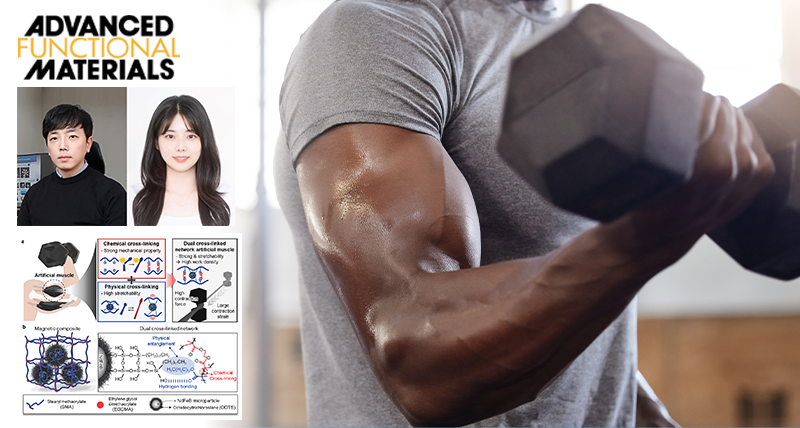
고무처럼 늘어났다가도 강철처럼 단단하게 변하는 인공 근육이 나왔다. 사람 근육이 수축해 무거운 물건을 드는 것처럼 이 인공 근육도 수축하면서 무게를 들 수 있는데, 이때 낼 수 있는 에너지가 사람 근육보다 30배 크다. UNIST 기계공학과 정훈의 교수팀은 강성을 자유자재로 바꿀 수 있는 소프트 인공 근육을 개발했다고 17일 밝혔다. 소프트 인공근육은 사람과 상호작용해야 하는 로봇, 웨어러블 기기, 의료 보조 장치 등에 활용될 수 있지만 무거운 물체를 드는 데에는 한계가 있다. 부드럽고 유연한 장점이 실제 힘을 쓰는 근육 역할에 방해가 되기 때문이다. 연구팀이 개발한 소프트 인공 근육은 하중을 지탱해야 하는 상태에서는 딱딱해지고, 이를 들어올려야 하는 상황에서는 부드러워져 수축할 수 있다. 딱딱한 상태에는 무게 1.25g에 불과한 이 인공 근육이 5kg 하중을 지탱할 수 있다. 자기 무게의 약 4,000배를 버티는 셈이다. 반면 부드러운 상태에서는 12배까지 늘어난다. 이 근육은 무게를 들어올리는 과정에서 원래 길이의 86.4%가 수축하는 구동 변형률을 보였는데, 사람 근육(약 40%)보다 두 배 이상 큰 수치다. 작업밀도도 사람 근육보다 30배 더 큰 1150 kJ/㎥를 기록했다. 작업 밀도는 1㎥ 크기의 근육이 얼마나 많은 일(에너지)을 할 수 있는지를 보여주는 지표다. 근육이 잘 변형되면서 단단할수록 작업 밀도가 커지는데, 일반적으로 두 조건은 서로 상충한다. [연구그림] 자기장을 가해서 움직일 수 있는 인공 근육의 내부 구조 연구팀은 근육 안에 두 가지 형태의 결합이 나타나도록 형상기억고분자 소재를 설계해 이 문제를 해결했다. 근육의 화학적 결합은 고분자 사슬을 공유결합으로 단단히 묶어 구조적 강도를 유지하게 하고, 물리적 결합은 열 자극에 따라 끊어졌다 다시 이어지며 근육을 유연하고 잘 늘어나게 만든다. 또 표면을 특수 처리한 자성 입자를 넣어 물리적 결합을 강화하고, 외부 자기장으로도 근육이 움직일 수 있도록 했다. 실제 자기장으로 근육을 움직여 물체를 집는 실험에도 성공했다. 정훈의 교수는 “이번 연구는 기존 인공근육이 잘 늘어나면 힘이 약하고, 힘이 세면 잘 안 늘어난다는 근본적 한계를 해결한 성과”라며, “앞으로 소프트 로봇, 웨어러블 로봇, 사람과 기계가 유연하게 상호작용할 수 있는 인터페이스 등 다양한 분야에서 활용될 수 있을 것”이라고 말했다. 이번 연구는 국제 학술지 ‘어드밴스드 펑셔널 머터리얼즈(Advanced Functional Materials)’에 2025년 9월 7일 온라인 게재됐으며, 한국연구재단의 지원을 받아 수행됐다.

연구성과

Research

2026년 05월 12일 화요일

Ultrafast 3D Microfabrication Technology Produces Complex Structures in Just 60 Seconds

Abstract Despite the advantages of additive manufacturing (AM) in creating customized 3D shapes, conventional layer-by-layer approaches are limited by low production rates, restricting their broader applications. Volumetric additive manufacturing (VAM) has emerged as a promising technique, enabling the simultaneous photopolymerization of entire volumes, which significantly reduces fabrication time. However, current computed axial lithography requires manual operations per print cycle, such as loading resin into a vial, physically placing and aligning the vial (with or without an index-matching medium), and removing the printed object, limiting continuous, high-throughput production of multiple parts. Here, we propose a dispensing volumetric additive manufacturing (DVAM) method that prints and dispenses each part within a droplet in less than a minute. The printing process occurs within a single droplet dispensed from a glass pipette, enabling simultaneous printed object removal and resin replenishment in a second. Light pattern distortion caused by the absence of the index-matching fluid was corrected through real-time droplet profile estimation and inverse ray-tracing within the optical system. We demonstrate rapid serial VAM of 10 different objects within 10 min. This approach establishes a practical pathway toward scalable, high-throughput volumetric manufacturing, enabling rapid production of complex 3D structures without the operational bottlenecks of conventional VAM workflows. A research team affiliated with UNIST has achieved a major breakthrough in 3D microfabrication, enabling the rapid production of intricate 3D structures within a single minute. The new technology promises to significantly accelerate manufacturing processes in fields, ranging from biomedical devices to microelectronics. Led by Professor Im Doo Jung from the Department of Mechanical Engineering at UNIST, the research team developed a cutting-edge dispensing volumetric additive manufacturing (DVAM) system.The new approach moves beyond traditional layer-by-layer methods, allowing for the swift, continuous fabrication of diverse three-dimensional shapes within a matter of minutes by employing a volumetric printing process. DVAM utilizes a fine resin droplet dispensed from a glass pipette as the entire build volume. Light is projected onto the droplet to cure the desired shape in real-time. Once a structure is solidified, compressed air expels the finished object, and a new droplet is immediately dispensed for the next cycle. This seamless process enables high-speed, continuous production without the need for post-processing or layer-by-layer assembly. Unlike conventional volumetric printing methods—such as Computed Axial Lithography (CAL)—which require filling a resin container, matching refractive indices with immersion fluids, and manually removing finished parts, the UNIST team’s approach eliminates these constraints. By performing printing within a single resin droplet that acts as the entire volume, they achieve rapid, uninterrupted manufacturing. One of the main challenges was optical distortion caused by the droplet’s curved surface. To overcome this, the researchers integrated artificial intelligence with inverse ray-tracing optical calculations. A deep learning-based AI accurately detects the droplet’s profile in real-time, enabling the system to mathematically correct for distortions and project precise light patterns for uniform curing. This advanced system successfully produced intricate structures, such as the Eiffel Tower and The Thinker, within just 10 minutes—demonstrating the ability to fabricate ten different objects with an average time of around 60 seconds each. Hongryung Jeon, the first author of the study, explained, “Unlike traditional 3D printing that builds objects layer by layer, our method cures the entire volume at once and continuously dispenses resin without additional post-processing, increasing speed by over 100 times. This opens up exciting possibilities for large-scale, rapid production of micro-scale components.” Professor Jung, the corresponding author, emphasized, “Speed has long been a limiting factor in 3D printing, especially for customized manufacturing. By moving away from conventional photopolymerization and employing artificial intelligence to compensate for optical distortions, we have significantly advanced the potential of ultrafast volumetric fabrication. Now, complex shapes can be produced in seconds—eliminating long wait times.” The findings of this research have been published online in Advanced Functional Materials (Impact Factor: 19.0, top 5% in JCR) on March 21, 2026. The project was supported by the National Research Foundation of Korea (NRF), the Ministry of Science and ICT (MSIT), the Institute for Information & communications Technology Planning & Evaluation (IITP), and the Ministry of Trade, Industry & Energy (MOTIE). Journal Reference Hongryung Jeon, Yunsoo Lee, Seobin Park, et al., "Dispensing Volumetric Additive Manufacturing," Adv. Funct. Mater., (2026).


2026년 04월 24일 금요일

UNIST to Establish KRW 38.2 Billion AI Ship Technology Testing and Validation Center

UNIST has secured a government-funded project to establish a testing and validation center for AI-based ship equipment and advanced components, marking a major step toward advancing Korea’s shipbuilding industry. The project, supported by the Ministry of Trade, Industry and Energy (MOTIE), was selected under a 2026 government initiative to strengthen infrastructure in the shipbuilding and offshore sector. With a total budget of KRW 38.2 billion, it will support the development and validation of AI-driven autonomous ship systems and advanced composite materials in response to tightening environmental regulations led by the International Maritime Organization (IMO), as well as evolving industry demands. Scheduled for completion by 2030, the center will be located in the Ulsan Mipo National Industrial Complex. UNIST will oversee its construction and operation in collaboration with the Ulsan Metropolitan Government, with participation from Ulsan Technopark, the Korea Testing & Research Institute (KTR), and the Korea Research Institute of Ships and Ocean Engineering (KRISO). Designed as an end-to-end validation platform, the facility will support the full development cycle—from design and prototyping to performance testing and certification readiness. In the advanced components domain, it will enable the validation of fiber-reinforced plastic (FRP)-based ship structures, exterior materials, and propulsion components under real-world operating conditions, including mechanical stress, corrosion, and cryogenic environments. The center will also incorporate AI- and digital twin-based manufacturing systems to enhance process optimization, quality control, and productivity. For AI-based ship systems, the center will establish a hybrid validation environment combining simulation and field testing, supporting the evaluation of autonomous navigation algorithms, sensor modules, and control systems in terms of safety, reliability, and repeatability, and accelerating commercialization. The center is expected to play a key role in supporting small and mid-sized shipbuilding suppliers by improving access to testing infrastructure and validation data, thereby strengthening industrial competitiveness and facilitating entry into global markets. Professor Young-Bin Park of the Department of Mechanical Engineering at UNIST, who leads the project, said, “This initiative will help bridge the gap between technology development and commercialization, supporting the advancement of environmentally sustainable and intelligent shipbuilding."

2026년 04월 23일 목요일

UNIST Unveils Smart Contact Lens with Meniscus Pixel Printing for Vision-Based Robotic Control

Abstract Contact lenses are emerging as strong candidates for next-generation extended reality (XR) interfaces due to their lightweight and ergonomic form factor. However, integrating photodetector arrays onto the limited area of a lens remains challenging with conventional micropatterning approaches, which rely on masks, multistep processes, and specialized equipment that inherently limit throughput and scalability. To address these constraints, we introduce a Meniscus Pixel Printing (MPP) strategy that enables rapid, mask-free patterning of MAPbI3 perovskite photodetectors without costly or complex fabrication tools. MPP uses a self-confined meniscus at a pipette tip to deterministically transfer perovskite ink, enabling 200 µm pixels to be printed within 1 s per pixel. In addition to planar substrates, MPP demonstrates stable pixel patterning on curved surfaces, highlighting its geometric adaptability and process versatility. Using this approach, we fabricate a 10 × 10 perovskite photodetector array and demonstrate stable photoresponse, retaining 92% of its initial performance after two months of storage. To overcome limited pixel density, a deep-learning-based super-resolution (SR) model reconstructs 10 × 10 inputs into 80 × 80 optical information with 97.2% accuracy and 0.03 s latency. Additionally, an AI-based eye-tracking system recognizes nine eye gestures with 99.3% accuracy, enabling smooth hands-free robotic arm control. A research team, led by Professor Im Doo Jung from the Department of Mechanical Engineering at UNIST, has developed a groundbreaking smart contact lens that enables users to control robots through eye movements. This innovative device combines embedded optical sensors with AI-based signal processing, offering a lightweight, intuitive human-machine interface with vast potential across industries. The lens incorporates a 10×10 array of light sensors capable of detecting subtle changes in light distribution caused by eye movements, including gaze direction and blinks. These signals are transmitted to control external robotic systems, as demonstrated with a robotic arm. Notably, the team employed a novel Meniscus Pixel Printing (MPP) technique to directly print sensors onto the curved lens surface without masks or complex fabrication steps, ensuring high precision and customizability. In addition to robotic control, the system demonstrates vision sensing capabilities by reconstructing optical information. To address the limited signal resolution inherent to micro-scale devices, the researchers applied deep-learning-based super-resolution algorithms, reconstructing high-fidelity signals equivalent to an 80x80 sensor array in just 0.03 seconds. This enables real-time, accurate control based solely on eye movements, achieving recognition accuracies of up to 99.3% under experimental conditions. This technology marks a significant advancement in ultra-compact human-machine interfaces, enabling precise, hands-free control of electronic devices. Potential applications include remote robotic operation, medical assistive devices, exploration in hazardous environments, defense systems, and smart mobility. Published in the March 2026 issue of Advanced Functional Materials (Impact Factor: 19.0, JCR Top 5%)—a top-tier journal in materials science—the research was selected as the Front Cover of the latest issue. The study received support from the National Research Foundation of Korea (NRF), the Ministry of Science and ICT (MSIT), the Institute of Information & Communications Technology Planning & Evaluation (IITP), and the Ministry of Trade, Industry, and Energy (MOTIE). Journal Reference Byung-Hoon Gong, Dohyean Kim, Jiyun Jeong, et al ., “Meniscus Pixel Printing for Contact-Lens Vision Sensing and Robotic Control,” Adv. Funct. Mater. , (2026).
2026년 04월 13일 월요일

UNIST Launches Major AI Initiative to Transform Shipbuilding Industry

UNIST has launched a major interdisciplinary research initiative to accelerate AI-driven transformation (AX) across the shipbuilding sector. Selected under the Ministry of Science and ICT’s national initiative for large-scale industrial AI, the project is supported by a total budget of KRW 40.3 billion (approximately USD 30 million). It aims to develop domain-specific AI foundation models trained on real-world shipyard data and deploy them in operational environments. The initiative brings together faculty from the Graduate School of Artificial Intelligence (AIGS), along with multiple engineering and business disciplines, forming a collaborative structure that spans the full lifecycle of industrial AI—from data generation and model training to system deployment and real-world validation. At the core of the project is the development of a multimodal, domain-specific foundation model for shipbuilding. This effort is led by Professor Sung Youb Kim from the Graduate School of Semiconductor Materials and Devices Engineering, with participation from Professors Seung-Hoon Na, Youngsoo Jang, Seungryul Baek, and Taehwan Kim from AIGS, along with Professor Hayoung Chung from the Department of Mechanical Engineering. The team will develop a model capable of integrating diverse data generated across shipyard operations, serving as a central engine for a wide range of downstream applications. Complementing this effort, a parallel workstream led by Professors Sung Whan Yoon, Jae-Young Sim, and Yeon-Chang Lee from AIGS, along with Professor Saerom Park (Department of Industrial Engineering) and Professor Seongil Wi (Department of Computer Science and Engineering) will establish a scalable industrial platforms for optimized for heterogeneous datasets. In parallel, Professors Seungjoon Yang, Gi-soo Kim, and Yeon-Chang Lee from AIGS will lead research on synthetic data generation, addressing limitations in real-world data and improving model robustness across diverse scenarios. Application-focused research will be led by Professors Youngdae Kim, Sungil Kim, Hyungho Na, Dong Young Lim, and Chiehyeon Lim from the Department of Industrial Engineering, along with Professor Junghoon Kim (Department of Computer Science and Engineering), Professor Jinyoung Choi (AIGS), and Professor Junhyoung Ha (Department of Mechanical Engineering). Their work will focus on manufacturing optimization, production scheduling, predictive maintenance, and the intelligent operation of collaborative robotic systems. The development of lightweight, on-device AI technologies will be led by Professors Taesik Gong (Department of Computer Science and Engineering), Jongeun Lee (Department of Electrical Engineering), and Ranggi Hwang (Department of Computer Science and Engineering). Meanwhile, Professors Byeong Ki Seo (School of Business Administration) and Namhun Kim (Department of Mechanical Engineering) will oversee field validation and service deployment to ensure practical application and scalability. To ensure real-world impact, the initiative will be carried out in close collaboration with industry partners, including HD Hyundai Heavy Industries, HD Korea Shipbuilding & Offshore Engineering, and CrowdWorks. By leveraging operational data from active shipyards, the consortium will validate and refine technologies through on-site implementation. Professor Seung-Hoon Na, who coordinates the overall project, stated, “This initiative goes beyond developing AI models—it establishes a foundation for industrial AX. By integrating AI into production planning, process optimization, and quality control, we expect to drive meaningful innovation across the shipbuilding industry.” The UNIST Office of Research Affairs supported the initiative through its Pre-Award pilot program, providing strategic and administrative assistance in proposal development, budgeting, and coordination. The university plans to further advance its research management framework to support large-scale, high-impact initiatives.

2026년 03월 31일 화요일

UNIST-Nurtured Startup RecensMedical Debuts on KOSDAQ!

A startup incubated at UNIST has successfully listed on the KOSDAQ, marking a significant milestone in the university's efforts to translate research into commercially viable technologies and foster globally competitive ventures. RecensMedical Inc., a faculty-founded startup established in 2016, began trading on the KOSDAQ on March 31, 2026. The company is based on proprietary research developed in the laboratory of Professor Gun-Ho Kim of the Department of Mechanical Engineering at UNIST. The company specializes in precision cooling-based medical devices for dermatology, ophthalmology, and veterinary applications. Its core technology enables real-time monitoring of tissue temperature and precise control of cooling intensity and duration, offering an alternative to conventional chemical anesthesia by reducing patient discomfort and improving procedural efficiency. "RecensMedical exemplifies how UNIST's foundational research can be transformed into impactful, market-ready solutions," said Professor Gun-Ho Kim, CEO of RecensMedical Inc. "We will continue to accelerate global expansion by securing regulatory approvals and strengthening international distribution channels." The company's public listing underscores the effectiveness of UNIST's R&D Scale-Up Strategy, which integrates the full innovation pipeline—from fundamental research and intellectual property development to startup incubation, manufacturing, and global market entry. UNIST has systematically supported technology commercialization by building strong patent portfolios from early-stage research, providing on-campus incubation infrastructure, and offering programs for prototyping, investment attraction, and overseas expansion. RecensMedical Inc. benefited from this ecosystem throughout its growth. In particular, UNIST’s GMP-certified manufacturing facilities played a critical role in securing regulatory approval from the Ministry of Food and Drug Safety (MFDS), enabling both product validation and commercialization. The company has also achieved steady growth through continued institutional and external support. It was selected as the first TIPS (Tech Incubator Program for Startup) in Ulsan in 2017 and later secured investment from a fund managed by UNIST Holdings in 2022. Additional support was provided through the Ulsan-Ulju INNOTOWN, where UNIST serves as a core technology institution. The initiative offers access to advanced research infrastructure, demonstration facilities, and R&BD funding, while facilitating connections to private investment and global mentoring networks. President Chong Rae Park stated, "UNIST's R&D Scale-Up Strategy emphasizes commercialization from the earliest stages of research. RecensMedical's growth demonstrates how integrated support—from technology validation to global collaboration—can translate research into real industrial impact. We will continue to strengthen an innovation ecosystem that connects research, industry, and global markets." RecensMedical Inc. has developed a portfolio of precision cooling devices designed to reduce pain and shorten treatment time across multiple clinical fields. Its flagship products include TargetCool for dermatology, OcuCool for ophthalmology, and VetEase for veterinary care. Following its KOSDAQ debut, the company is positioned to accelerate global commercialization and further establish itself as a leader in precision cooling medical technology.

2026년 02월 19일 목요일

Revolutionary High-Performance ECG Patch Eliminates Cold Gel and Irritating Adhesives

Abstract Skin-interfacing electrodes are essential for wearable bioelectronics, yet conventional gel- and dry-type electrodes often suffer from dehydration, poor skin conformity, irritation, and delamination during motion, limiting their long-term performance. Here, a self-attachable liquid metal channel (S-LMC) patch is presented that integrates open-bottom Galinstan microchannels and micropillar arrays, both featuring re-entrant geometries for enhances skin adhesion and leakage suppression. A via-hole interconnect enables direct vertical signal transmission, eliminating the need for bulky wiring and facilitating compact integration. The patch achieves strong, reusable skin adhesion (>60 kPa), low contact impedance (7.35 kΩ·cm2 at 10 Hz), and minimal skin irritation. Compared to commercial Ag/AgCl gel electrodes, the S-LMC patch exhibits >5× lower impedance, >2× higher ECG signal fidelity (20.23 dB vs. 9.03 dB under motion), and >2.4× higher long-term adhesion after 7 days. Its re-entrant microarchitecture also improves Galinstan confinement, achieving >2× higher critical pressure for leakage. These features enable motion-resilient biosignal monitoring and scalable system integration, establishing the S-LMC patch as a promising platform for next-generation skin-conformal bioelectronic interfaces. Conventional ECG patches often require cold gels and adhesives, which can cause skin irritation and leave marks. These materials can also lose effectiveness during vigorous movement, compromising signal quality. Addressing these issues, UNIST researchers have developed a novel, self-adhesive ECG patch that eliminates the need for gels and chemical adhesives. Led by Professor Hoon Eui Jeong of the Department of Mechanical Engineering, the team introduced an innovative design integrating liquid metal microchannels with microstructured silicone elastomers. The patch features a spiral-shaped liquid metal channel—about 20 micrometers wide—that directly contacts the skin through an open-bottom structure. This configuration enables direct transmission of cardiac signals to the electrodes, ensuring high-fidelity recording even during intense physical activity. To prevent liquid metal leakage, the researchers incorporated inwardly curled horizontal microstructures at the base of the channels. This structural feature effectively contains the liquid metal, maintaining device integrity under pressure. Moreover, the ultra-thin microchannels—less than 20 micrometers thick—prevent the patch from feeling cold or uncomfortable against the skin. The entire surface of the patch is embedded with microprotrusions measuring 28 micrometers in diameter and 20 micrometers in height, which serve as physical anchors. These crown-like structures conform tightly to the skin’s microcurvatures, significantly enhancing adhesion. As a result, the patch maintains a strong, reusable bond that withstands vigorous movements such as walking or running. Figure 1. Design and key advantages of the S-LMC patch Performance evaluations demonstrated that the new patch’s electrode impedance is over five times lower than that of commercial products, enabling the detection of weak signals with greater clarity. Its robust adhesion—capable of supporting a weight of 100 grams—ensures stable contact during physical activity. Importantly, even after seven days of repeated use, the patch maintained more than twice the adhesion strength of conventional disposable patches, reducing motion artifacts and improving signal stability. Unlike traditional patches that rely on adhesives and gels, this device is durable and can be reused over 500 times. Its structural adhesion mechanism remains effective over prolonged use, and it maintains high signal accuracy without the need for gels that dry out and impair performance over time. Professor Jeong remarked, "We have successfully solved the challenges of liquid metal leakage and skin adhesion through precise structural design. This technology lays the foundation for next-generation wearable health monitoring systems, especially for patients with sensitive skin, and for high-precision human-machine interfaces." The research team is currently collaborating with Anvix Lab Co., Ltd. to commercialize the technology. Recognized for its innovation, the project was selected for the TIPS program supported by the Ministry of SMEs and Startups, and initial investments are already underway. Founded by Professor Jeong and Professor Jae Joon Kim of the Department of Electrical Engineering, Anvix Lab Co., Ltd. aims to lead the future of wearable healthcare devices by integrating this advanced patch technology with on-chip AI solutions. The findings of this research have been featured as Inside Front Cover of the January 2026 issue of Advanced Science. The research was supported by the Ministry of Science and ICT (MSIT), the Ministry of Trade, Industry & Energy (MOTIE), and the National Research Foundation of Korea (NRF). Journal Reference Sang-Woo Lee, Hyeonseok Song, Jinseo Kim, et al., "Self-Adhesive Liquid Metal Channel Patch with Tip-Guided Conformal Coupling and Leakage Suppression for Skin Bioelectronics," Adv., Sci., (2025).

2026년 02월 04일 수요일

New Adaptive PID Control Allows Industrial Robots to Handle Sudden Heavy Loads without Vibrations

Abstract Proportional-integral-derivative (PID) equipp-ed controllers are widely used in industrial robots potentially facing substantial payload and environmental variations. Their widespread use may impede the implementation of advanced robust control methods. This study presents a robust adaptive PID control algorithm that is model-independent, simple, and suitable for deployment on commercial PID-equipped devices. The proposed adaptive PID control is based on a modified version of adaptive time-delay control employing modified Nussbaum functions to ensure stability under substantial variations of robot and environment dynamics, and includes straightforward gain drift prevention schemes. The performance of the proposed adaptive PID control was experimentally evaluated with other PID controls and advanced model-independent control, showing enhanced robustness and no gain drift. These results demonstrate the potential of the proposed PID control for immediate deployment in industrial robots with a PID-equipped controller. A groundbreaking control technology has been developed to enable robotic arms to manage sudden heavy loads without excessive vibrations. This innovative solution can be implemented instantly through a simple software update to existing industrial robot controllers—used in over 90% of manufacturing facilities worldwide. Researchers, led by Professor Sanghoon Kang from the Department of Mechanical Engineering at UNIST announced the successful development of an adaptive proportional-integral-derivative (PID) control algorithm, capable of maintaining stable operation even under abrupt load changes or external impacts. PID controllers serve as the brain of robotic arms, calculating the force needed to follow a desired trajectory in real time. Due to their simplicity and proven reliability, they are the dominant control method in industrial robotics. However, conventional PID systems lack flexibility. They rely on fixed parameters, making them vulnerable to malfunctions or vibrations if the load suddenly varies or the robot encounters external contact. To overcome this limitation, the research team developed an algorithm that enables robots to automatically fine-tune their control parameters in real time based on error feedback. Unlike traditional adaptive PID systems, their approach is specifically engineered to counteract the minute signal noise—called quantization errors—generated by digital sensors in robot joints. Previous adaptive algorithms often overreacted to this noise, causing unnecessary force adjustments and system instability. Figure 1. Experimental setup of a planar two-DOF direct-drive five-bar robot with hardware and software architecture and kinematic structure. A hook in end-effectors allows the robot to be connected with external dynamics. A key advantage of this new technology is that it requires only a software update—no hardware modifications, complex parameter inputs, or costly additional sensors are necessary. Any robot equipped with a PID controller can adopt this algorithm immediately. The team demonstrated the effectiveness of the algorithm on a two-joint robotic arm under challenging conditions, such as lifting weights equal to its own mass and operating in environments with complex spring mechanisms. Results showed that the robot could adaptively adjust its control parameters to follow precise trajectories, despite environmental disturbances. In contrast, traditional control methods exhibited larger positional errors and instability. Professor Kang remarked, "This development offers a significant enhancement in the performance of PID controllers, which are prevalent in industrial automation. It has broad potential applications—from smart factories with dynamic work environments to rehabilitation robots that respond to subtle human forces, and even humanoid robots." The findings of this research have been published in the January 2026 issue of IEEE/ASME Transactions on Mechatronics, one of the most respected journals in the fields of mechanical and robotic engineering. This work was supported through the Future Promising Fusion Technology Pioneer Project by the National Research Foundation of Korea (NRF) and by the National Rehabilitation Center (NRC). Journal Reference Jeongwoo Son, Hyunah Kang, Murim Kim, et al., "Robust Adaptive PID Control Based on a Modified Nussbaum Function for Robots Exposed to Significant Changes in Dynamics," TMECH, (2025).

2026년 01월 12일 월요일

Professor Sang Hoon Kang Honored with 'IJPEM Most Cited Article Award'

Professor Sang Hoon Kang of the Department of Mechanical Engineering at UNIST has been honored with the Most Cited Article Award from the International Journal of Precision Engineering and Manufacturing (IJPEM), a leading international journal in robotics and manufacturing engineering. The award recognizes researchers whose work has demonstrated outstanding academic impact. Professor Kang's paper was selected as the most cited paper published in IJPEM between 2023 and 2024, highlighting its influence within the field of robot control and manufacturing engineering. Their paper, titled 'A Review on Robust Control of Robot Manipulators for Future Manufacturing,' was published in the April 2023 issue of IJPEM. The review examines robust control techniques for robot manipulators, with a particular focus on the theoretical development and practical applicability of Time-Delay Control (TDC). In the paper, Professor Kang brings together more than three decades of accumulated research on TDC, offering a systematic overview of its evolution and use in real-world applications. He shows that TDC enables stable and efficient control of complex robotic systems—including humanoid robots, rehabilitation robots, and industrial manipulators—despite the challenges posed by nonlinearity and time-varying dynamics. The study has been widely cited for providing a clear and comprehensive reference long sought by researchers in the field. Reflecting on the award, Professor Kang said, "This work is meaningful in that it presents, for the first time, a comprehensive review of control methods that can be applied in practice even to highly nonlinear and complex robotic systems. The citation record shows that many researchers have been seeking a systematic understanding of TDC." He added, "I will continue to pursue research on more robust and efficient control techniques that can be applied across a wide range of robotic systems, including humanoid and rehabilitation robots."

2025년 12월 24일 수요일

New Study Unveils Innovative Carbon Fiber-Based Water Droplet Power Generator

Abstract Automated and effective urban stormwater management (USM) is essential to address the increase in stormwater hazards due to climate change and urbanization. Although droplet-based electricity generators (DEGs) can help monitor dynamic environmental changes in real-time, they have limited long-term reliability. Herein, a superhydrophobic fiber-reinforced polymer-based DEG (S-FRP-DEG) is proposed for efficient USM. The fiber-reinforced polymer (FRP), composed of carbon fiber fabric, carbon fiber tow (CFT), glass fiber fabric, and epoxy, offers a high strength-to-weight ratio and corrosion resistance. A spray coating of polydimethylsiloxane and polytetrafluoroethylene particles on the FRP creates a superhydrophobic surface with a water contact angle of 167°, enabling rapid droplet contact and separation over large areas. The coating accords self-cleaning ability and forms a negatively charged surface, enhancing energy harvesting performance. A closed circuit forms upon droplet impact on the superhydrophobic surface and contact with the adjacent CFT, generating up to 117.93 mW m−2 per droplet. Textured finish formed by peel ply during FRP manufacturing further improves energy generation and coating durability. The S-FRP-DEG can be configured with multiple CFTs to increase the energy storage rate, enabling LED operation and autonomous USM. This technology provides a practical solution for energy-efficient urban management and supports smart city development. A research team, affiliated with UNIST has introduced a technology that generates electricity from raindrops striking rooftops, offering a self-powered approach to automated drainage control and flood warning during heavy rainfall. Led by Professor Young-Bin Park of the Department of Mechanical Engineering at UNIST, the team developed a droplet-based electricity generator (DEG) using carbon fiber-reinforced polymer (CFRP). This device, called the Superhydrophobic fiber-reinforced polymer (S-FRP-DEG), converts the impact of falling rain into electrical signals, capable of operating stormwater management systems without an external power source CFRP composites are lightweight, yet durable used in a variety of applications, such as aerospace and construction for its strength and resistance to corrosion. Such characteristics make it well suited for long-term outdoor installation on rooftops and other exposed urban structures. The generator produces electricity through a process similar to static charge generation. When a positively charged raindrop contacts the device's negatively charged superhydrophobic surface, electric charge is transferred as the droplet rapidly detaches and rolls away. This motion drives an electric current through embedded carbon fibers, generating power almost instantly. Figure 1. Structure and Working Mechanism of S-FRP-DEG. Unlike conventional metal-based droplet generators, which are prone to corrosion from moisture and urban pollutants, the CFRP-based design maintains stable performance under harsh environmental conditions. The research team further improved efficiency by introducing a textured surface and lotus-leaf-inspired coating that enhances water repellency while preventing the buildup of dirt and soot. Traditional droplet generators made from metals often suffer from corrosion caused by pollution and moisture. This new CFRP-based device overcomes that problem with excellent durability and stability over time. In laboratory tests, a single raindrop with a volume of approximately 92 microliters generated up to 60 volts and a few microamps of current. When four units were connected in series, the system briefly powered 144 LED lights, demonstrating its scalability. The team also validated the technology in real-world settings by installing the device on building rooftops and drainage pipes. As rainfall intensity increased, the electrical signals became stronger and more frequent, allowing the system to distinguish between light, moderate, and heavy rain and automatically activate drainage pumps when necessary. "This technology enables urban infrastructure to monitor rainfall and respond to flood risks using only the energy of rain itself," said Professor Park. "Looking ahead, it could be further integrated into mobility systems, including vehicles or aircrafts, where carbon fiber composites are already widely used." The study was led by Dr. Seong-Hwan Lee and Dr. Jae-Jin Kim, as first authors. Funded by the Ministry of Science and ICT (MSIT) and the National Research Foundation (NRF) of Korea, the research was published in the online version of Advanced Functional Materials on November 20, 2025. Journal Reference Seonghwan Lee, Jaejin Kim, and Young-Bin Park, "Structural Droplet-Based Electricity Generator Using Superhydrophobic Fiber-Reinforced Polymer for Smart Stormwater Management," Adv. Funct. Mater., (2025).

2025년 12월 18일 목요일

Two Faculty Members Awarded Minister of Education Commendation

Two UNIST faculty members—Professor Kyudong Choi of the Department of Mathematical Sciences and Professor Jae Hwa Lee of the Department of Mechanical Engineering—have been selected for the Top 50 Outstanding Academic Research Achievements by the Ministry of Education, an annual recognition honoring significant outcomes from government-supported research. This year, 245 research results from projects funded in 2024 were submitted through nominations and open calls. Following evaluation for originality, academic quality, and scholarly contribution, 50 works were selected. Awardees were given a Minister of Education Commendation at the ceremony held on December 9 at the Grand InterContinental Hotel in Seoul. Professor Kyudong Choi was recognized for resolving a long-standing theoretical problem in rotating fluid motion that had remained open for more than 130 years. His research addresses the mathematical stability of vortex structures that arise in rapidly rotating flows, such as those observed in typhoons. Figure 1. The streamline of Hill's spherical vortex in the moving frame. Such flows are often modeled using Hill’s spherical vortex, a classical solution in fluid dynamics. However, the model’s discontinuous boundary has long made it difficult to determine whether these vortices can exist stably. Professor Choi and his team proposed a new analytical framework that applies boundary conditions closer to those found in natural systems, allowing previously intractable discontinuities to be handled in a mathematically rigorous way. Using this approach, the team proved for the first time that spherical vortices can remain stable while maximizing kinetic energy under specific conditions. The study provides a theoretical foundation for the stability of three-dimensional localized vortices and represents a meaningful advance in the field of fluid dynamics. The research was published in Communications on Pure and Applied Mathematics (CPAM), one of the leading journals in pure and applied mathematics, and also received the Korean Mathematical Society (KMS) Paper Award. "This work reflects the growing international presence of Korean research in fundamental mathematics," Professor Choi said. "I hope it helps broaden the theoretical basis for studies in fluid stability and climate-related phenomena." Professor Jae Hwa Lee was selected for his research on bio-inspired underwater propulsion, based on the swimming mechanics of manta rays. While many existing designs rely on actively controlling an entire flexible structure, Professor Lee's work focuses on passive flexibility, in which only the leading edge is controlled and the rest of the motion emerges through interaction with surrounding fluid. Figure 2. 3D vortical structures visualized by the isosurface of Q-criterion (Q = 1.5) around the ray when (i) t/T = 4/8, (ii) t/T = 5/8, (iii) t/T = 6/8, and (iv) t/T = 7/8: (a) active case and (b) passive case with ζc = 10−4. The isosurface of Q = 1.5 is colored by the horizontal component of vorticity (ωx). The team found that this mechanism generates strong vortex structures along the body and maintains positive pressure even at higher speeds, enabling greater thrust with lower energy consumption. The study has been noted for proposing an alternative, efficiency-focused approach to underwater propulsion. Their findings were published in Physics of Fluids, an international journal in fluid mechanics. "Collaboration across disciplines was essential to this research," Professor Lee said. "We plan to combine these findings with AI-based control techniques and extend the work to autonomous underwater vehicles and bio-inspired robotic systems." UNIST President Chong Rae Park congratulated the researchers, noting that their achievements reflect UNIST's emphasis on connecting foundational theory with practical innovation.